
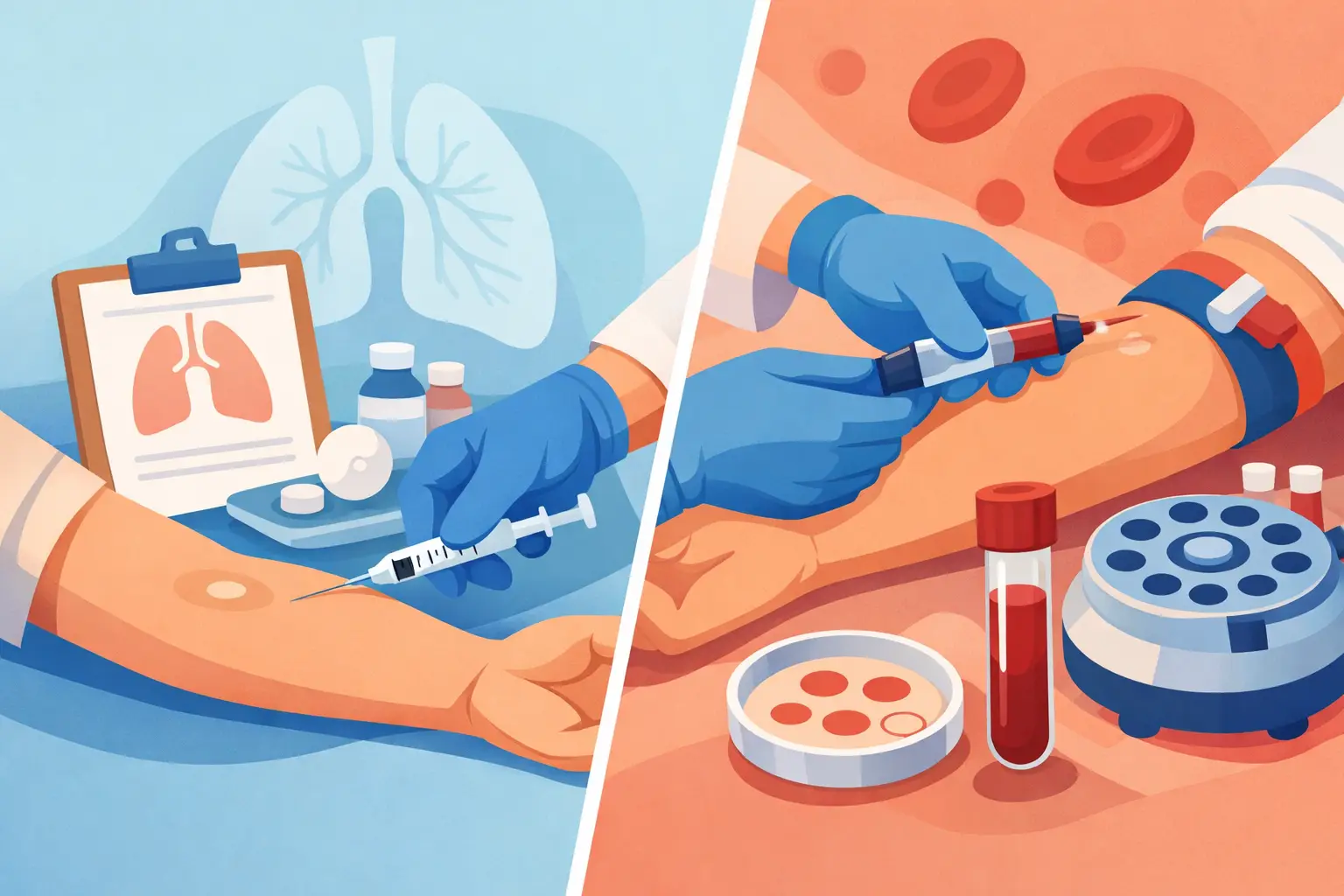
A TB skin test vs blood test decision often comes down to a few practical details: whether you received the BCG vaccine, whether you can return for a second visit, and what your employer, school, or program requires. Both tests can help identify tuberculosis infection, but neither test alone confirms active TB disease.
If you need TB testing for work, school, volunteer placement, immigration, or a possible exposure, a clinician can help determine which option fits your medical history and documentation requirements. The right test is the one that provides a reliable result and can be completed within the timeline you need.
TB Skin Test vs Blood Test: The Main Difference
The TB skin test, also called a tuberculin skin test or TST, is placed just under the skin of the forearm. A small raised bump appears at the injection site. You must return to the clinic 48 to 72 hours later so a trained healthcare professional can measure any firm swelling at the site.
The TB blood test is commonly called an interferon-gamma release assay, or IGRA. It requires one blood draw. The sample is sent to a laboratory, where it is tested for the body’s immune response to TB bacteria. Results are usually available after laboratory processing, rather than during the same visit.
Both tests are designed to identify TB infection, including latent TB infection. Latent TB means TB bacteria are present in the body but are inactive and not causing symptoms. A person with latent TB does not spread TB to others, but treatment may be recommended to reduce the chance of developing active disease later.
When a TB Skin Test May Be a Good Option
The skin test remains a widely used option, especially when an organization specifically requests it. It may be appropriate for people who can return within the required 48- to 72-hour reading window and who have no reason to expect a misleading result from prior BCG vaccination.
The test is usually quick to place and does not require a blood draw. For patients who need a two-step TST for employment or training, the process involves two skin tests placed and read at separate times. This is sometimes required for baseline screening in settings where future TB exposure could occur.
The main limitation is the return visit. If the test is not read during the correct timeframe, it generally needs to be repeated. A skin test also requires careful interpretation. The size of the firm swelling, not redness alone, is measured, and the meaning of that measurement depends on a person’s health history and risk factors.
When a TB Blood Test May Be Preferred
A blood test can be especially useful for people who received the BCG vaccine. BCG is used in many countries to help protect children from severe forms of TB. It can sometimes cause a positive skin test even when a person does not have TB infection. TB blood tests are not affected by prior BCG vaccination in the same way.
A blood test is also convenient for patients who cannot reliably return for a skin-test reading. One appointment for the blood draw may be easier for people balancing work, school, caregiving, or travel. It can also avoid uncertainty when a previous skin test was positive but the person’s risk of TB infection is low.
Availability, cost, insurance coverage, and the requirements of the requesting organization may affect the choice. Some programs accept either test, while others specify one method. Confirm the requirement before booking so you do not need to repeat testing later.
What Can Affect TB Test Results?
A positive result does not automatically mean someone has active, contagious TB disease. It means further evaluation is needed to determine whether TB infection is present and whether there are signs of active illness. A clinician may review symptoms, assess your health history, order a chest X-ray, and arrange additional testing when appropriate.
A negative result also does not rule out every situation. Testing can be less reliable if it is performed too soon after exposure, before the immune system has had time to respond. After a recent exposure, a clinician may recommend initial testing and repeat testing about 8 to 10 weeks after the last possible exposure.
Certain health conditions and medications can affect the body’s immune response and lead to a false-negative result. This may include significant immune suppression, some cancer treatments, advanced kidney disease, or medications that weaken immune function. Young children and people who are seriously ill may also need individualized testing decisions.
Skin tests can produce false-positive results because of BCG vaccination or exposure to certain bacteria that are not TB. Blood tests can occasionally produce indeterminate results, meaning the laboratory could not provide a clear positive or negative answer. In either case, your clinician will consider your symptoms, risk factors, exposure history, and the reason for testing rather than relying on one result in isolation.
Choosing Between a TB Skin Test and Blood Test
The best choice is not always the fastest test. Consider the following practical factors before arranging your test:
- BCG vaccination history: A blood test is often preferred if you received BCG, particularly if you may have difficulty interpreting a positive skin test.
- Ability to return: A skin test requires a return visit in 48 to 72 hours. A blood test requires one draw, although you must still receive the result.
- Program requirements: Employers, schools, healthcare placements, and public agencies may have specific documentation rules.
- Recent exposure or health conditions: Timing and individual risk can affect whether one test, repeat testing, or further evaluation is needed.
For many routine screening situations, either test may be suitable. For patients with prior BCG vaccination, a history of positive skin tests, or limited availability for a follow-up visit, the blood test may offer a clearer and more practical route.
Symptoms That Need More Than Routine Screening
Routine TB testing is not a substitute for medical assessment when symptoms suggest active TB. Seek prompt medical care if you have a persistent cough, coughing up blood, chest pain, unexplained fever, night sweats, ongoing fatigue, or unexplained weight loss. Risk may be higher after close contact with someone who has active TB or after extended time in an area where TB is more common.
If active TB is a concern, a clinician may recommend a chest X-ray and tests on sputum or other samples. A skin test or blood test can support the assessment, but it cannot tell on its own whether TB disease is active or whether someone is contagious.
Preparing for Your TB Test Appointment
Bring any forms that need to be completed, along with records of previous TB test results, chest X-rays, TB treatment, or BCG vaccination if available. Tell the healthcare professional about recent TB exposure, symptoms, major health conditions, pregnancy, and medications that affect your immune system.
If you are having a skin test, plan ahead for the required reading visit. Do not assume a photograph of the injection site can replace an in-person measurement. If you are having a blood test, ask when and how results will be provided and whether your organization needs a particular report format.
TB testing is most useful when the test type, timing, and follow-up plan match your situation. A brief conversation with a clinician before testing can prevent missed deadlines, repeated appointments, and uncertainty about what your result means.
Leave a Reply