
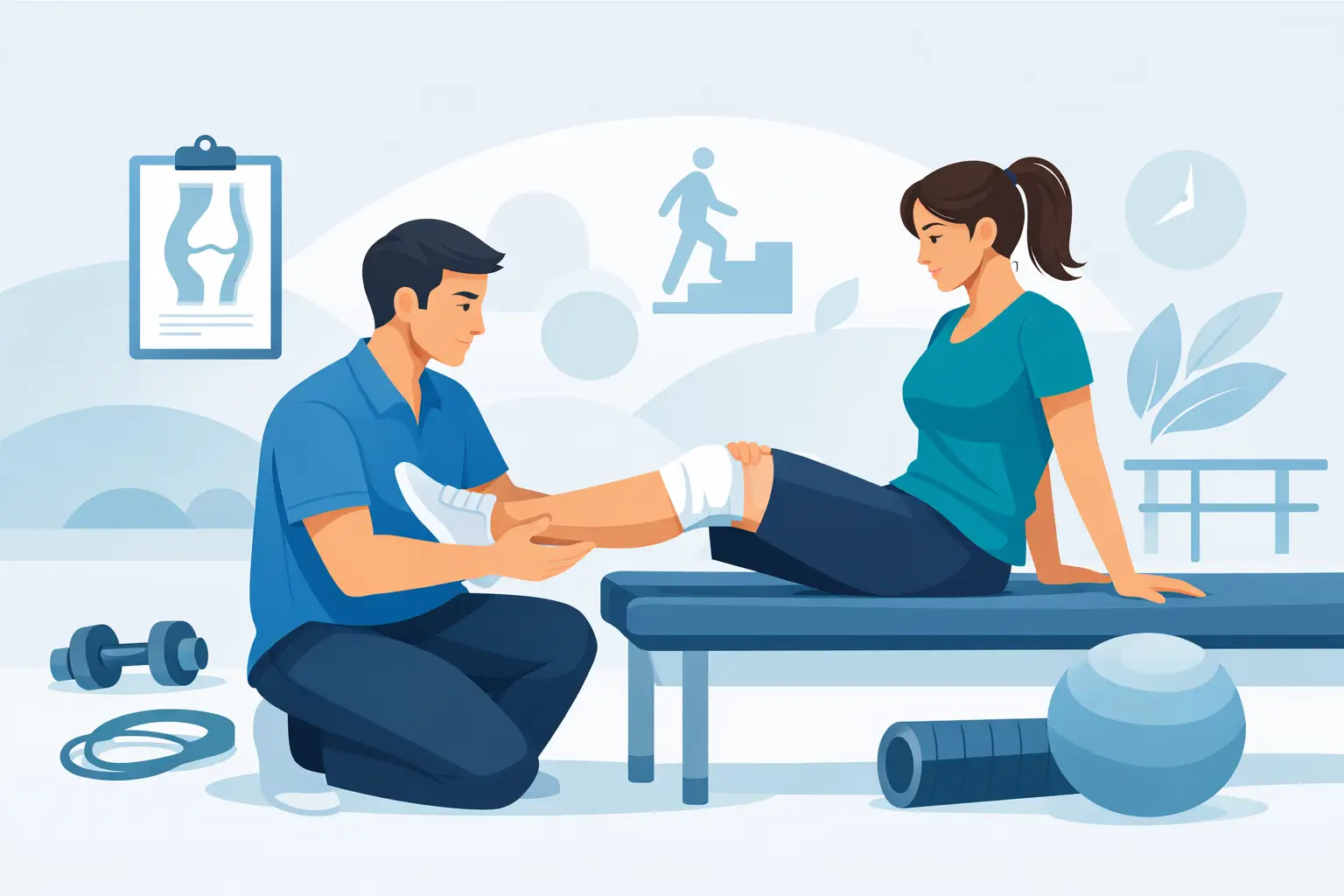
The first few days after a knee injury often bring the same question: should you rest it completely, or start moving it? For many patients, the safest path is somewhere in the middle. Rehab exercises after knee injury can help restore motion, reduce stiffness, and rebuild strength, but timing and exercise selection matter.
A knee can be injured in several ways, from a ligament sprain and meniscus irritation to a fall, twist, overuse flare, or direct impact. Because the knee depends on coordinated support from the quadriceps, hamstrings, glutes, and calf muscles, weakness in one area can keep symptoms going longer than expected. That is why recovery usually involves more than simply waiting for pain to settle.
When to start rehab exercises after knee injury
For minor injuries, gentle movement often begins early, sometimes within days, if weight bearing is tolerated and there are no red-flag symptoms. Early motion may help prevent stiffness and reduce the cycle of guarding that makes walking harder. That does not mean pushing through sharp pain. It means choosing low-load movements that support recovery instead of aggravating the joint.
The timeline depends on the injury. A mild strain may improve quickly with guided exercise, while a suspected ligament tear, fracture, dislocation, or large swelling episode needs medical assessment first. If your knee gives out, locks, looks deformed, cannot bear weight, or swells rapidly after injury, you should be evaluated before starting a home program.
What good knee rehab is trying to achieve
Early rehabilitation usually focuses on four goals: reducing pain, restoring range of motion, improving control, and gradually rebuilding strength. Many patients want to jump straight to strengthening, but a knee that cannot fully bend or straighten normally will often stay irritated. Just as important, muscles need to relearn how to support the joint during everyday tasks such as standing, stairs, and walking.
Progress is rarely linear. Some soreness with exercise can be acceptable, especially when tissues are deconditioned, but symptoms should settle within about 24 hours. If pain spikes, swelling increases, or walking becomes worse after each session, the program is probably too aggressive.
Early rehab exercises after knee injury
The earliest phase is usually simple. The goal is to keep the knee moving and wake up surrounding muscles without placing too much force through the joint.
Heel slides
Lie on your back or sit with your leg supported. Slowly slide your heel toward your body to bend the knee, then slide it back out. This helps maintain bending range without impact. Move only within a comfortable range at first, then increase gradually.
Quad sets
With the leg straight, tighten the front thigh muscle by pressing the back of the knee gently downward into the bed or floor. Hold briefly, then relax. This is one of the most useful early exercises because the quadriceps often shut down after injury, even when the injury itself is relatively minor.
Straight leg raises
If you can keep the knee straight without pain increasing, tighten the thigh and lift the leg a short distance off the surface, then lower slowly. This builds early quadriceps control. If the knee bends during the lift or discomfort increases significantly, it may be too soon.
Ankle pumps and calf activation
Moving the ankle up and down improves circulation and helps maintain lower leg mobility when activity is reduced. It is not a knee-strength exercise on its own, but it supports early recovery, especially after a period of rest.
Supported knee extension
Some patients lose the ability to fully straighten the knee after injury. Resting the heel on a pillow or rolled towel so the knee is gently encouraged toward extension can help, if tolerated. This should feel like a mild stretch, not a forced position.
Building strength as pain improves
Once swelling is more controlled and basic walking is improving, strengthening becomes more functional. At this stage, the goal is not just to exercise the knee, but to improve how the whole leg handles load.
Sit-to-stand
Standing up from a chair with controlled form is one of the most practical knee rehab exercises. Use a stable chair, keep both feet planted, and rise slowly without dropping back down. If needed, use your hands for support at first.
Mini squats
A small squat, performed with good alignment and limited depth, can strengthen the quadriceps and glutes without placing excessive stress on an irritated knee. Depth matters. For many people early on, a shallow range is more appropriate than a deep bend.
Step-ups
Using a low step, step up and down slowly while keeping the knee aligned over the foot. This helps prepare the leg for stairs and daily activity. If pain appears mainly when stepping down, that often signals reduced control rather than just weakness.
Bridges
Lying on your back with knees bent, lift the hips while keeping the movement smooth and controlled. Bridges strengthen the glutes and hamstrings, which can reduce strain through the front of the knee during walking and stair use.
Calf raises
Standing and lifting onto the toes helps rebuild calf strength and lower limb stability. The calf plays an important role in walking, balance, and shock absorption, all of which matter during knee recovery.
Balance and control are often the missing piece
A knee injury does not only affect strength. It can also reduce balance, coordination, and confidence in the leg. That is why many patients feel unstable even after pain has improved.
Simple balance drills, such as standing on one leg near a counter for support, can help retrain control. As recovery progresses, tasks like slow marching, controlled weight shifts, or gentle reach movements can be added. These exercises are especially relevant after sprains, twists, or injuries that caused the knee to buckle.
What to avoid during recovery
The wrong exercise is usually not wrong forever. It is just wrong for the current stage. Deep squats, twisting motions, jumping, running, and pivoting often need to wait until pain, swelling, and strength are better controlled. Trying to return to sports or high-impact activity too early can restart the cycle of irritation.
It is also common for patients to rest too long. Prolonged inactivity can lead to more stiffness, weaker muscles, and slower recovery. The better approach is usually guided progression – enough activity to promote healing, but not so much that the knee stays inflamed.
Signs you may need a supervised rehab plan
Home exercise can be effective for mild cases, but some situations benefit from in-person assessment. Ongoing swelling, repeated giving way, reduced range of motion, pain that is not improving, or trouble returning to work and regular walking are all good reasons to get support.
Supervised rehabilitation can help identify whether the main issue is mobility, muscle inhibition, gait changes, or poor load tolerance. That matters because two patients with the same diagnosis may need different exercise progressions. One may need to regain extension first, while another needs hip strength and better movement mechanics.
At a clinic such as Twin Mills Medical Centre, coordinated access to medical assessment and rehabilitation support can make that process more straightforward, especially when patients want practical next steps instead of managing multiple appointments in different locations.
A simple way to pace rehab
Most patients do well with short sessions performed consistently. Ten to fifteen minutes once or twice a day is often more useful than one long session that leaves the knee flared up. Start with a small number of repetitions, monitor the response later that day and the next morning, and progress gradually.
A reasonable rule is this: mild discomfort during exercise can be acceptable, but limping more, swelling more, or losing motion afterward usually means you need to scale back. Recovery should challenge the knee without overwhelming it.
When it is safe to return to normal activity
Returning to normal activity depends on function, not just time. You should be able to walk with a normal pattern, fully or nearly fully straighten and bend the knee, and tolerate daily tasks without increased swelling. For sports or physically demanding work, the bar is higher. Strength, balance, and movement control should be close to the uninjured side.
This is one reason some people feel fine during basic movement but are not ready for cutting, sprinting, kneeling, or repeated stair climbing. The knee may be quieter, but not fully prepared. A gradual return usually leads to better outcomes than testing it all at once.
The most helpful approach is to treat knee rehab as a progression, not a race. Start with the simplest movements your knee can tolerate, build consistency before intensity, and get assessed if pain, instability, or swelling is slowing you down.
Leave a Reply